donottrack.us – Domain Analyse

Donottrack.us belegt im phpFK Technik-Ranking Platz # 17.101. Die geprüfte Zieladresse lautet https://www.eff.org/issues/do-not-track und antwortet über HTTPS mit dem HTTP-Status 200. Die durchschnittliche Ladezeit beträgt 0.25 Sekunden. Die IP-Adresse der Website lautet 217.70.184.38. Im HTML wurden 6 Bilder, 0 interne Links und 169 externe Links erfasst. Der Bericht wurde zuletzt am 8. November 2026 aktualisiert.


Anzeige
Transparenz und Prüfung

Über diese Domainbewertung

Die Bewertung von donottrack.us folgt einheitlichen Prüfkriterien. Frank Karau übernimmt als namentlich genannter Autor die Verantwortung für die Veröffentlichung.

Autor
Frank Karau
Prüfverfahren
Auswertung öffentlich erreichbarer Website-Daten nach einheitlichen Prüfkriterien mit redaktioneller Kontrolle und Freigabe.
Prüfumfang
100 technische Einzelprüfungen
Bewertungsmodell
Version 1.0
Letzte Prüfung
8. November 2026
Nächste reguläre Prüfung
7. Februar 2027 · spätestens nach 90 Tagen
Transparenter Korrekturweg

Domainangaben zu donottrack.us ergänzen oder korrigieren

Du vertrittst diese Domain? Reiche einen Korrekturhinweis, eine Stellungnahme oder eine Entfernungsanfrage ein. Die Bestätigung erfolgt über eine E-Mail-Adresse der Domain; anschließend wird jeder Vorgang manuell geprüft.

Domainhinweis sicher einreichen

donottrack.us – Interaktionen in sozialen Netzwerken

Facebook 0 Gefällt-mir-Angaben/geteilte Inhalte
Google Plus 0 +1s
Pinterest 0 Pins
Linkedin 0 geteilte Inhalte
StumbleUpon 0 Stumbles

donottrack.us – Onpage-Analyse der Website

Titel
Do Not Track | Electronic Frontier Foundation

Länge: 45 Zeichen

Meta-Keywords

Länge: 0 Zeichen

Meta-Beschreibung
What is online tracking? Online advertising is big business. According to industry groups, revenues for online ads exceeded $150 billion USD in 2021 and continue to grow every year. Those ads are powered by online tracking, profiling, and targeting: a…

Länge: 376 Zeichen

Suchergebnis-Vorschau
Do Not Track | Electronic Frontier Foundation
donottrack.us/
What is online tracking? Online advertising is big business. According to industry groups, revenues for online ads exceeded $150 billion USD in 2021 and…
SEO-Dateien
robots.txtPrüfung nicht möglich
sitemap.xmlPrüfung nicht möglich
Sprache der Website
Englisch

en

donottrack.us – phpFK-Technikscore

77,0von 100 Punkten100 Einzelprüfungen · Modell 1.0
Erreichbarkeit und HTTP100,0 / 100
HTTPS und Sicherheit40,0 / 100
Geschwindigkeit170,0 / 180
Crawlbarkeit90,0 / 130
Onpage-Grundlagen110,0 / 120
Mobile Darstellung60,0 / 100
Links und Ressourcen41,7 / 90
Strukturierte Daten60,0 / 80
Barrierefreiheit68,3 / 70
Messqualität30,0 / 30

Der Technikscore basiert ausschließlich auf selbst erhobenen technischen Messwerten. Er ist keine Besucherzahl und keine Google-Platzierung.

Prüfverlauf – donottrack.us

Entwicklung des Technik-ErgebnissesMessstände werden nur nach einer tatsächlich durchgeführten Prüfung gespeichert.
Aktueller Ausgangswert77,0 / 1008. November 2026

Für donottrack.us liegt derzeit eine Ausgangsmessung vor. Nach der nächsten regulären Prüfung werden Veränderungen des Gesamtscores und der einzelnen Prüfkategorien hier nachvollziehbar dargestellt.

donottrack.us – Technische Website-Prüfung

Indexierbarkeit und Canonical
IndexierungErlaubt
Links folgenErlaubt
Abruf laut robots.txtErlaubt
Meta-RobotsNicht angegeben
GooglebotNicht angegeben
X-Robots-TagNicht angegeben
Canonical entspricht ZieladresseJa
Weiterleitungen und HTTPS
Weiterleitungskette301 → 200
SSL-Zertifikat akzeptiertJa
Strukturierte Daten
Gültige JSON-LD-Blöcke0
Erkannte TypenNicht angegeben
Fehlerhafte JSON-LD-Blöcke0
Social-Media-Angaben
Open-Graph-TitelDo Not Track
Open-Graph-BeschreibungWhat is online tracking? Online advertising is big business. According to industry groups, revenues for online ads exceeded $150 billion USD in 2021 and continue to grow every year. Those ads are powered by online tracking, profiling, and targeting: a vast corporate surveillance network that harvests and analyzes our every click, query, and more. The average web page shares data with dozens of third parties. The average mobile app does the same, and many apps collect highly sensitive information like location, even when they’re not in use. Digital tracking also reaches into the physical world: shopping centers use automatic license-plate readers to track traffic through their parking lots; businesses, concert organizers, and political campaigns use Bluetooth and WiFi beacons to perform passive monitoring of people in their area; and retail stores use face recognition to identify customers, screen for theft, and deliver targeted ads. In order to target ads to users based on their online behaviors, the ad-tech industry relies on sophisticated tracking techniques that collect information about users as they browse the web and interact with apps on their mobile devices. Users are tagged with unique identifiers to pinpoint them and categorize their consumer behaviors into cohorts and micro-audiences: users from a certain neighborhood who are interested in used Audi cars, for instance. On mobile devices, advertisers can use an identifier provided by the phone itself, in the form of a unique advertising identifier. Advertisers also use cross-device tracking to link a users’ mobile devices to their workstation and other devices they may have in the home, forming an overall picture of their usage of all the different devices they interact with. Princeton researchers found that the vast majority of online tracking comes from large tech firms such as Google and Facebook, and is disproportionately on sites that rely heavily on advertising revenue like news and arts websites. How does tracking happen on the web? On the web, tracking is most often performed with cookies—specifically third-party cookies, which come from sites that the user doesn’t even directly visit, but are instead loaded by the “first-party” site the user is on. For instance, a news site may include an advertisement or interactive game from an advertiser server that is able to set cookies on a user’s browser. If this advertiser is loaded on multiple sites a user visits, the advertiser will be able to track that user across multiple sites via the cookie they set previously. One way to evade these trackers is to “clear cookies” on your browser. But this won’t always protect from other forms of web tracking. For example, browser fingerprinting uses different characteristics of a person’s browser (such as language, time zone, and fonts) that are not on their own unique, but when combined will uniquely identify a specific browser. What is Do Not Track? A number of initiatives have attempted to limit the scope of online tracking. Originally proposed in 2009, the Do Not Track (DNT) web header sent a signal from a user’s browser to all sites they visited stating that user’s preference not to be tracked. The DNT header initiative suffered from lackluster adoption by browsers and a lack of mechanisms to enforce the user's preference. To give the preference some teeth, EFF introduced our own DNT Policy, which sites could incorporate into their own privacy policies, and thus promise not to track browsers that opted out using the DNT header. In return, tracker blockers such as our own Privacy Badger would not block sites which abided by this policy. Eventually, DNT was superseded by individual browser initiatives to block or limit trackers, and was abandoned by standards bodies such as the W3C. What is Global Privacy Control? In 2020, a new specification titled Global Privacy Control (GPC) was introduced at the W3C. It picks up momentum where DNT began to lag. It also pairs with the newly passed California Consumer Privacy Act (CCPA) and the now well-known GDPR. At its core, it works like DNT: a user’s browser sends a distinct signal to websites it visits that invokes the GPC. But now, the signal is legally binding to companies in places with applicable privacy laws. In California, for example, it allows users to opt out of having their data shared or sold. This automated, “one and done” opt-out tool is far easier for people to use than manually opting-out, one at a time, at all the sites that a person visits.  Tools such as Privacy Badger have incorporated this functionality, coupled with the DNT controls that are already in place. This new specification is tailored to requirements of new laws like CCPA. However, it doesn’t completely protect users from the dangerous advertising and tracking industry, given gaps in current law. How do I prevent myself from being tracked? EFF’s own Privacy Badger is a browser extension that automatically learns to block invisible trackers. It identifies the third-party resources you encounter across the web, determines which are trackers, and prevents those trackers from being loaded. In this way, it allows the useful third-party resources that are needed to display a webpage and help it function properly, while blocking the unnecessary and invasive trackers. Other browser extensions such as uBlock Origin and Disconnect can be used in combination with Privacy Badger to provide a defense in-depth approach, layering different protections against trackers in your browser. Browsers themselves have introduced various protections against web tracking as well. Apple’s Safari browser and iOS use Intelligent Tracking Prevention to protect against the latest tracking technologies. Enhanced Tracking Protection in Firefox uses the Disconnect block list as well as a number of Mozilla’s own techniques to block trackers. Brave is a privacy-focused browser employing a unique set of protections of its own, including protection against browser fingerprinting technologies. Users who wish to protect themselves against not only online trackers but also more advanced threats may consider Tor Browser, which puts an anonymous web-browsing experience above all else. Note: this is an updated page. View the original archived version.
Twitter-/X-Cardsummary
Twitter-/X-TitelDo Not Track
Twitter-/X-BeschreibungWhat is online tracking? Online advertising is big business. According to industry groups, revenues for online ads exceeded $150 billion USD in 2021 and continue to grow every year. Those ads are
Mobile Darstellung
Viewportwidth=device-width
Gerätebreite berücksichtigtJa
Bilderprüfung
Ohne ALT-Attribut1
Leeres ALT-Attribut2
Lazy Loading0
Mit Breite und Höhe2
Sicherheits-Header
HSTSFehlt
Content-Security-PolicyFehlt
X-Content-Type-OptionsVorhanden
Referrer-PolicyFehlt
Permissions-PolicyFehlt
Technische Auslieferung
HTML-Größe56,8 KB
Content-Typetext/html; charset=utf-8
ZeichencodierungUTF-8
KomprimierungGZIP
DNS-Informationen
IPv6Nicht angegeben
Nameserverns-181-c.gandi.net, ns-227-b.gandi.net, ns-85-a.gandi.net
Mailserverspool.mail.gandi.net, fb.mail.gandi.net
Sitemap-Auswertung
DateitypNicht angegeben
Enthaltene URLs0
Verknüpfte Sitemaps0
Sitemap-Angaben in robots.txt0
Sprachversionen
Hreflang-Angaben1
Sprachen und Regionenen
x-defaultNicht angegeben
Auszeichnung für Webmaster

phpFK-Technikpokal auf der eigenen Website zeigen

Mit diesem kostenlosen Badge kannst Du das aktuelle Ergebnis der technischen Websiteprüfung sichtbar machen. Die Grafik wird direkt von phpFK geladen und übernimmt automatisch den veröffentlichten Technikscore, die Anzahl der Prüfungen, das Bewertungsmodell und das letzte Aktualisierungsdatum.

  • HTML-Code vollständig kopieren
  • Im HTML- oder Code-Block der eigenen Website einfügen
  • Speichern – weitere Aktualisierungen erscheinen automatisch

Überprüfbare Originaldaten: Die sichtbaren Werte stehen nicht als veränderbarer Text im Einbettungscode. Ein Klick auf den Pokal führt immer zum zugehörigen öffentlichen phpFK-Bericht.
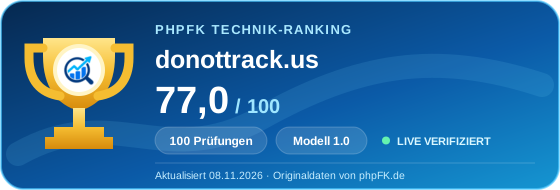
phpFK-Technikranking für donottrack.us
Die Badge-Grafik wird höchstens sechs Stunden zwischengespeichert und danach automatisch mit den aktuellen phpFK-Daten abgeglichen.

Sie sind Inhaber dieser Domain und möchten den Eintrag löschen lassen: abuse@phpfk.de

donottrack.us Erfahrungen

Teile Deine Erfahrungen mit donottrack.us oder lies, was andere Nutzer über diese Domain berichten.

Hinweis: Kommentare über diese Domain geben ausschließlich die persönliche Meinung des jeweiligen Verfassers wieder. phpFK prüft die geschilderten Erfahrungen nicht auf ihre inhaltliche Richtigkeit. Rechtswidrige, beleidigende, werbliche oder offensichtlich missbräuchliche Beiträge werden nicht veröffentlicht.

Erfahrung zu donottrack.us teilen

Deine E-Mail-Adresse wird nicht veröffentlicht. Beiträge können vor der Veröffentlichung moderiert werden.